


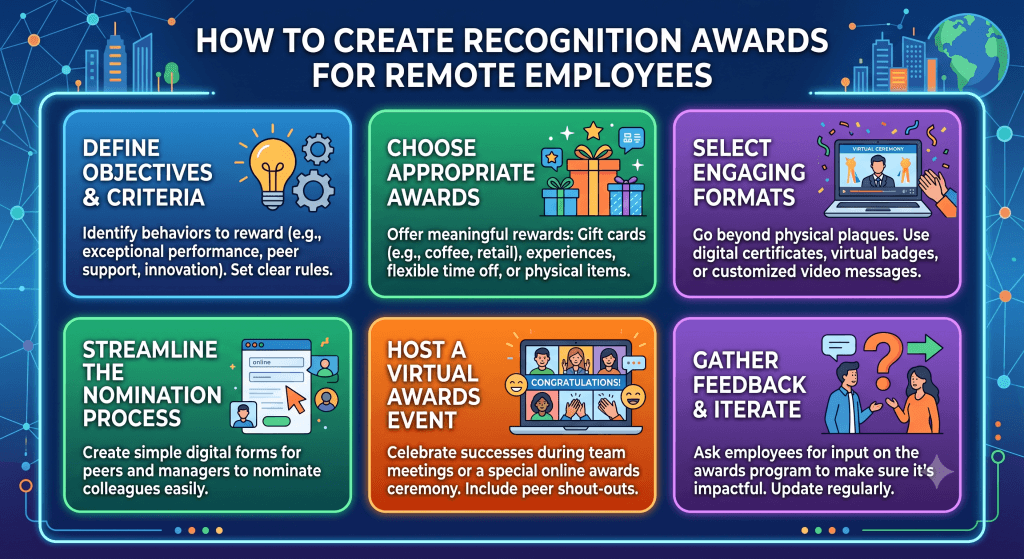
Remote and hybrid working arrangements allow companies to recruit talented employees regardless of location. However, they can also make employee recognition more challenging.
When employees do not regularly meet their managers and colleagues in person, their contributions may be less visible. Informal recognition moments—such as applause during a meeting, congratulations in the office, or an award presentation at a company dinner—may also happen less frequently.
A thoughtfully designed recognition award can bridge this distance. It provides remote employees with a tangible reminder that their work is noticed, appreciated, and connected to the company’s success.
Creating an effective award for a remote employee involves more than engraving a name on a trophy. Companies must choose an appropriate award category, design, message, presentation method, and delivery experience.
This guide explains how to create meaningful recognition awards for remote employees.
Why Remote Employees Need Meaningful Recognition
Remote employees may work independently for long periods, communicate mainly through digital platforms, and have fewer spontaneous interactions with senior leaders.
Without intentional recognition, they may feel that their efforts are less visible than those of office-based employees.
A structured recognition programme helps companies:
- Show employees that their contributions are noticed
- Reinforce desired behaviours and company values
- Celebrate individual and team achievements
- Improve connections between remote employees and leadership
- Create shared moments across different locations
- Strengthen employee pride and motivation
- Support a more inclusive company culture
A physical award provides something that a video call, email, or chat message cannot: a lasting symbol of achievement that employees can display in their home workspace.
Companies exploring the wider benefits of formal recognition can read more about how corporate awards support employee retention.
1. Define What the Award Recognises
Before selecting the design, decide what achievement or behaviour the award will celebrate.
Remote employee awards should recognise specific contributions rather than simply reward visibility or participation in online meetings.
Possible award categories include:
- Remote Employee of the Year
- Outstanding Virtual Leadership Award
- Remote Collaboration Excellence Award
- Digital Innovation Award
- Customer Service Excellence Award
- Outstanding Project Contribution Award
- Remote Team Player Award
- Above and Beyond Award
- Long Service Award
- Online Mentor of the Year
- Communication Excellence Award
- Remote Problem-Solver Award
The category should reflect an accomplishment that employees understand and value.
For example, a Remote Collaboration Excellence Award could recognise an employee who consistently supports colleagues in different locations, shares knowledge, communicates clearly, and helps virtual projects stay on schedule.
Clear award criteria make the recognition feel fair, credible, and meaningful.
2. Connect the Award to Company Values
Recognition awards are most effective when they reinforce the values and behaviours the company wants to encourage.
Instead of creating only general performance awards, consider categories connected to values such as:
- Innovation
- Integrity
- Teamwork
- Customer focus
- Accountability
- Inclusivity
- Continuous improvement
- Adaptability
- Leadership
- Service excellence
For instance, a company that values adaptability could create an Agile Excellence Award for a remote employee who handled changing priorities while continuing to deliver strong results.
The award design should also reflect the company’s visual identity. Brand colours, logos, typography, and meaningful symbols can transform a generic trophy into a distinctive company recognition piece.
Our guide on designing awards that reflect company branding explains how brand values and visual elements can be incorporated into a custom award.
3. Choose the Right Award Material
The material influences the award’s appearance, weight, durability, price, and suitability for delivery.
Crystal Awards
Crystal awards create a premium and prestigious impression. Their clarity, brilliance, and substantial weight make them appropriate for significant achievements, including:
- Employee of the Year
- Leadership recognition
- Long-service milestones
- Major project achievements
- Lifetime contribution awards
A personalised crystal plaque can also provide enough space for the employee’s name, award title, company logo, date, and recognition message.
Read our guide on choosing a crystal plaque for employee recognition before selecting the shape and engraving style.
Acrylic Awards
Acrylic awards are lightweight, durable, versatile, and easy to customise. They are particularly practical when awards must be shipped to employees in different cities or countries.
Acrylic can be:
- Cut into custom shapes
- Printed with brand colours
- Designed with layered effects
- Combined with different bases
- Personalised for multiple award categories
Explore our range of acrylic awards for suitable recognition designs.
Customised Awards
A fully customised award may be appropriate when the company wants something closely connected to its industry, product, logo, or culture.
For example, a technology company could create an award inspired by digital connectivity, while an international business could incorporate a globe, map, or interconnected shapes.
Companies looking for distinctive designs can explore our customised awards.
For additional guidance, compare the characteristics of both materials in our article on crystal versus acrylic trophies.
4. Select a Home-Office-Friendly Design
An award for a remote employee will probably be displayed in a home office rather than a corporate trophy cabinet.
The design should therefore be impressive without being difficult to accommodate.
Consider the following:
Size
Choose a compact or medium-sized award that can fit comfortably on a desk, bookshelf, or cabinet.
An oversized trophy may be inconvenient in a small home workspace, while an award that is too small may not reflect the significance of the achievement.
Stability
The award should have a stable base so it can be displayed safely. This is particularly important for crystal pieces with greater weight.
Visibility
The employee’s name and award title should remain easy to read when the piece is displayed on a shelf or desk.
Style
Select a design that looks professional in both personal and work environments. Clean geometric shapes, plaques, stars, and freestanding crystal or acrylic pieces are versatile options.
Durability
Because the award will be packaged and delivered, choose a material and structure that can be protected securely during transportation.
5. Personalise Every Award
Personalisation turns a standard trophy into a meaningful recognition item.
At a minimum, the award should include:
- Employee’s full name
- Award title
- Company name or logo
- Year or presentation date
You may also include:
- Department or team
- Specific project name
- Years of service
- Company value demonstrated
- Brief appreciation message
- Signature or name of the company leader
Avoid using only generic phrases such as “For Outstanding Performance.” Explain what the employee actually accomplished whenever space allows.
For example:
Presented to Sarah Lim in recognition of her outstanding leadership, clear communication, and commitment to connecting our regional teams throughout 2026.
A specific message shows that the award was created for the recipient rather than selected from a standard template.
6. Create a Fair Selection Process
Remote employees should have the same opportunity to receive recognition as employees working from the office.
Managers should avoid selecting recipients based only on who speaks most frequently during meetings or who has the most direct contact with leadership.
A fair selection process may include:
- Clearly published eligibility requirements
- Measurable award criteria
- Manager nominations
- Peer nominations
- Customer feedback
- Project results
- Examples of company values in action
- Review by a recognition committee
Companies with employees in different locations should also consider time zones, language differences, job responsibilities, and access to high-visibility projects.
Recognition should reward meaningful contributions—not physical proximity to decision-makers.
7. Plan the Virtual Award Presentation
Receiving the award should feel like an occasion, even when the presentation happens online.
Instead of briefly announcing the winner at the end of a routine meeting, create a planned recognition moment.
A virtual award presentation could include:
- An introduction explaining the award category
- Examples of the recipient’s contribution
- Comments from managers or colleagues
- The official announcement
- A visual preview of the personalised award
- Time for the recipient to respond
- A team photograph or screenshot
The presenter should explain why the employee was selected. This gives the recognition greater emotional value and shows other employees which behaviours the organisation appreciates.
For larger companies, the presentation can be included in a virtual town hall, quarterly meeting, annual awards event, or hybrid company celebration.
8. Coordinate the Delivery Carefully
The physical delivery is an important part of the recognition experience.
Before placing the order, confirm:
- Employee’s preferred name
- Correct spelling
- Award title
- Delivery address
- Contact number
- Delivery deadline
- Country-specific shipping requirements
- Whether the parcel should remain a surprise
The award should be packaged securely and presented professionally. A premium box can protect the item while creating a more memorable unboxing experience.
Consider including a personalised letter from the manager or senior leader. The letter can provide more detail than the award itself and explain the impact of the employee’s work.
Companies ordering personalised awards should allow enough time for artwork preparation, approval, engraving, production, packaging, and delivery. Review the Crystallin Works award ordering process before confirming your event schedule.
9. Make the Recognition Visible to the Wider Team
Public recognition helps remote employees feel connected to the organisation and allows colleagues to celebrate their success.
With the recipient’s permission, companies can share the achievement through:
- Internal newsletters
- Company intranet announcements
- Team communication platforms
- Virtual town halls
- Recognition boards
- Company social-media pages
- Employee spotlight articles
- Video interviews
The announcement should explain what the recipient achieved and why the contribution mattered.
However, companies should also respect individual preferences. Some employees enjoy public attention, while others may prefer recognition within a smaller team setting. Ask recipients about their comfort level before publishing personal details or photographs.
10. Create a Consistent Recognition Programme
A single award can create a positive moment, but a structured programme builds a lasting recognition culture.
Establish a regular schedule for awards, such as:
- Monthly performance recognition
- Quarterly values awards
- Annual excellence awards
- Project-completion awards
- Service-anniversary awards
- Immediate awards for exceptional contributions
Consistency is important. Employees should know when awards are presented, how nominations work, and what criteria are used.
At the same time, avoid creating too many categories. When awards are handed out without clear standards, they may begin to feel less meaningful.
A focused programme with credible criteria is more effective than a large number of generic awards.
Common Mistakes to Avoid
Using Generic Award Messages
An award without a specific achievement or personal message may feel impersonal.
Forgetting Remote Employees
Ensure remote and hybrid employees are included in every company-wide recognition programme.
Announcing the Award Before Delivery Arrangements Are Ready
Coordinate production and shipping so the recipient does not have to wait an unnecessarily long time after the announcement.
Choosing an Impractical Design
Consider the recipient’s home workspace and the requirements of secure delivery.
Misspelling the Recipient’s Name
Check all names, dates, job titles, logos, and messages before approving the artwork.
Focusing Only on Individual Performance
Remote work often depends on collaboration. Include team, mentoring, communication, and support-related award categories.
Treating the Presentation as an Afterthought
A meaningful introduction and explanation can be as important as the physical award itself.
Creating Recognition That Reaches Beyond the Office
Remote employees should not feel less appreciated simply because they work outside the company’s physical office.
A well-planned recognition award gives remote employees a lasting reminder that their work matters. By choosing relevant award categories, applying fair criteria, creating a personalised design, and organising a thoughtful virtual presentation, companies can make recognition meaningful across any distance.
At Crystallin Works, we design and produce premium crystal, acrylic, and customised awards for employee recognition programmes. Our team can help you select an appropriate design, personalise each award, and prepare your order for delivery to remote or hybrid employees.
Contact Crystallin Works to discuss your award categories, design preferences, quantity, personalisation requirements, and delivery schedule.
Frequently Asked Questions
1. What type of award is best for a remote employee?
The best option depends on the importance of the achievement, the company’s budget, and the delivery requirements. Crystal awards are suitable for prestigious milestones, while acrylic awards are lightweight, durable, and highly customisable. A compact design is usually most practical for a remote employee’s home workspace.
2. What information should be included on a remote employee award?
Include the recipient’s name, award title, company name or logo, and presentation date. You can also include the employee’s department, years of service, project name, company value demonstrated, or a short message describing the achievement.
3. How can we present an employee award virtually?
Present the award during a planned video meeting, virtual town hall, or hybrid ceremony. Explain why the employee was selected, share examples of their contribution, show an image of the personalised award, and invite colleagues to congratulate the recipient.
4. Should the award be delivered before or after the virtual ceremony?
Delivering the award before the ceremony allows the employee to open or display it during the presentation. However, this may reveal the surprise. Another option is to announce the award virtually and arrange delivery immediately afterwards. The right approach depends on the event format and delivery schedule.
5. How early should companies order awards for remote employees?
Order as early as possible to allow time for design selection, artwork approval, personalisation, production, quality checks, packaging, and delivery. Additional time may be required when awards are being sent to multiple locations or international recipients.


